Loading...

A scholar guides youth through China’s career crisis.
80%
Originality
95%
Accuracy
0%
Upvotes
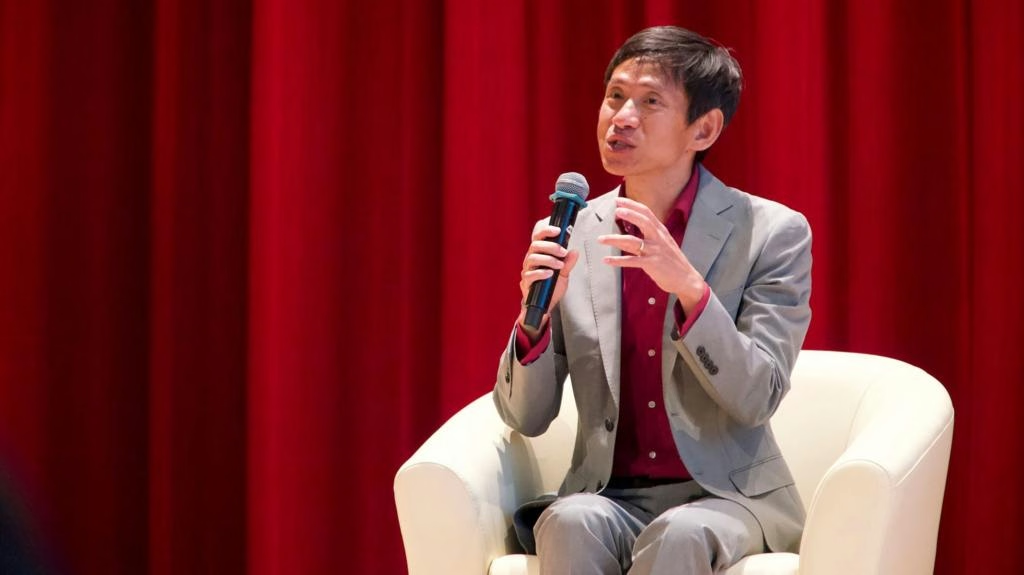
A 54-year-old anthropologist has become an unexpected cultural guide for young Chinese people navigating economic pressure and social uncertainty. Professor Biao Xiang recently addressed roughly 500 attendees in an auditorium in Singapore, drawing a crowd that queued for hours to take photos and share their concerns. Many describe his appearances as academic fan meetings.

The demand for his guidance stems from a generation facing a rapidly shifting landscape. China’s economy expanded at breakneck speed, but the old promise that hard work guarantees a secure career no longer holds. Youth unemployment reached 21.3% before the government stopped publishing the figures in mid-2023. Young workers now navigate long hours, toxic office environments, and an unofficial age cutoff known as the curse of 35, after which finding new employment grows significantly harder.
Xiang provides a framework that resonates with these pressures. He describes the relentless effort to simply survive as floating, comparing it to a hummingbird that must keep flapping to stay airborne. He also points to involution, a state where intense competition yields little meaningful reward. "When 1.4 billion people are all in the same race, that is involution," he explains. Online users frequently credit him for grounding his lectures in real-life dilemmas rather than offering hollow reassurance.
According to Xiang, two major forces drive this exhaustion. A property boom tied family security to home values, while a massive expansion in university enrollment raised the baseline for achievement. The result is a rigid, universal playbook: secure a degree, land a stable position, marry, and buy a home. When that path feels blocked, the pressure fractures. Social media users often describe the transition from campus to professional life as a source of deep uncertainty. One graduate noted that young adults require a steady reference point during these shifts, and Xiang’s messaging provides exactly that sense of being understood.
Xiang’s public approach has drawn mixed reactions from his academic peers. Some colleagues worry that engaging with mass audiences risks damaging scholarly reputation. Xiang, who now directs the Max Planck Institute for Social Anthropology in Germany, welcomes the attention. "If someone calls me an influencer I'll take it as a compliment. Because the real influence I can have is to make people think for themselves," he said. He views his role as helping people name their anxieties so they can analyze and manage them rather than avoid them.

He traces his own understanding of societal shifts to his childhood in Wenzhou in 1972, when China opened to global trade and small businesses flourished. That era of rapid growth taught him that economic foundations can change quickly. Today, he encourages young people to look beyond distant national narratives and focus on their immediate surroundings. He acknowledges that confronting these pressures can feel overwhelming, but argues that naming a problem is the first step toward handling it.